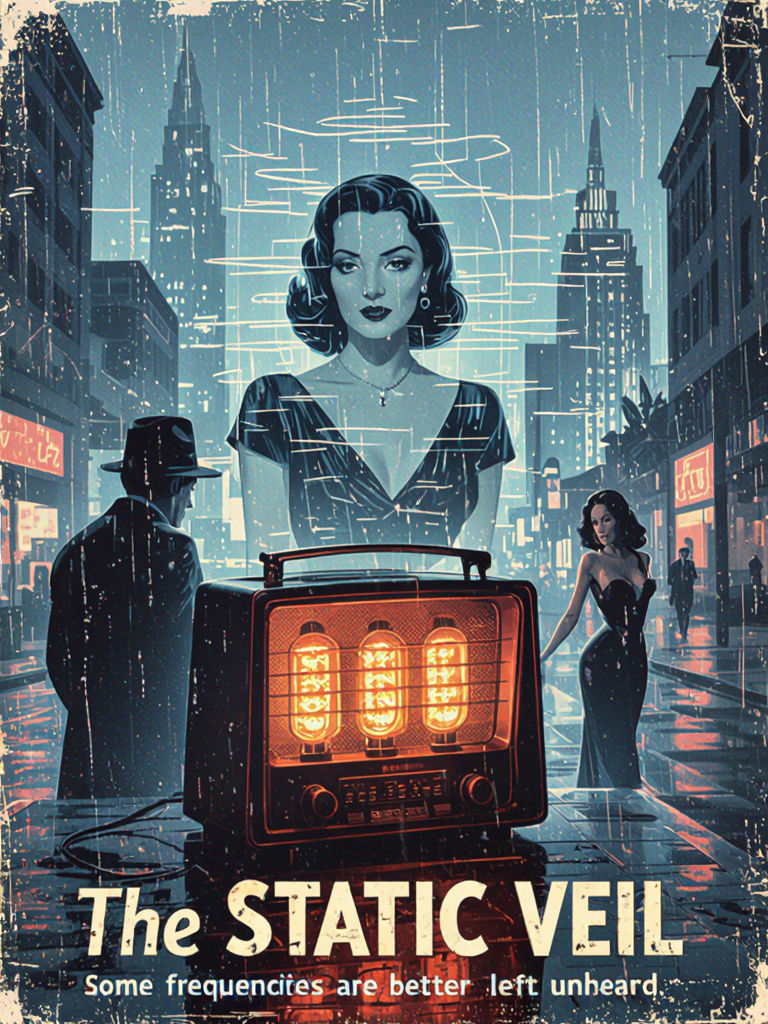
The Static Veil
In 1948 Los Angeles, a cynical radio repairman specializing in haunted broadcasts discovers a hidden frequency within a deceased heiress’s final transmission—a ghostly echo revealing her murder—but as he delves deeper into the static-filled mystery, he finds himself haunted not only by the victim's spirit, but by a manipulative femme fatale and a shadowy network of occultists who will stop at nothing to keep the truth—and the source of the eerie signal—silenced.
"The Static Veil" In 1948 Los Angeles, a cynical radio repairman specializing in haunted broadcasts discovers a hidden frequency within a deceased heiress’s final transmission—a ghostly echo revealing her murder—but as he delves deeper into the static-filled mystery, he finds himself haunted not only by the victim's spirit, but by a manipulative femme fatale and a shadowy network of occultists who will stop at nothing to keep the truth—and the source of the eerie signal—silenced.
a moody film noir movie poster, 1948 Los Angeles, rain-slicked streets, a vintage radio with glowing tubes dominates the foreground, static crackling visibly around it, a ghostly, translucent silhouette of a beautiful woman (the heiress) overlaid on the radio's speaker, a man (the repairman) in a fedora, back partially to the viewer, examining the radio with a worried expression, a glamorous but dangerous woman (femme fatale) lurking in the background shadows, art deco architecture in the distance, overall color palette of deep blues, greys, and blacks with glowing neon accents, dramatic lighting, film grain, “The Static Veil” title prominently displayed in a vintage, slightly distorted font, tagline: "Some frequencies are better left unheard.", highly detailed, cinematic, 35mm film.