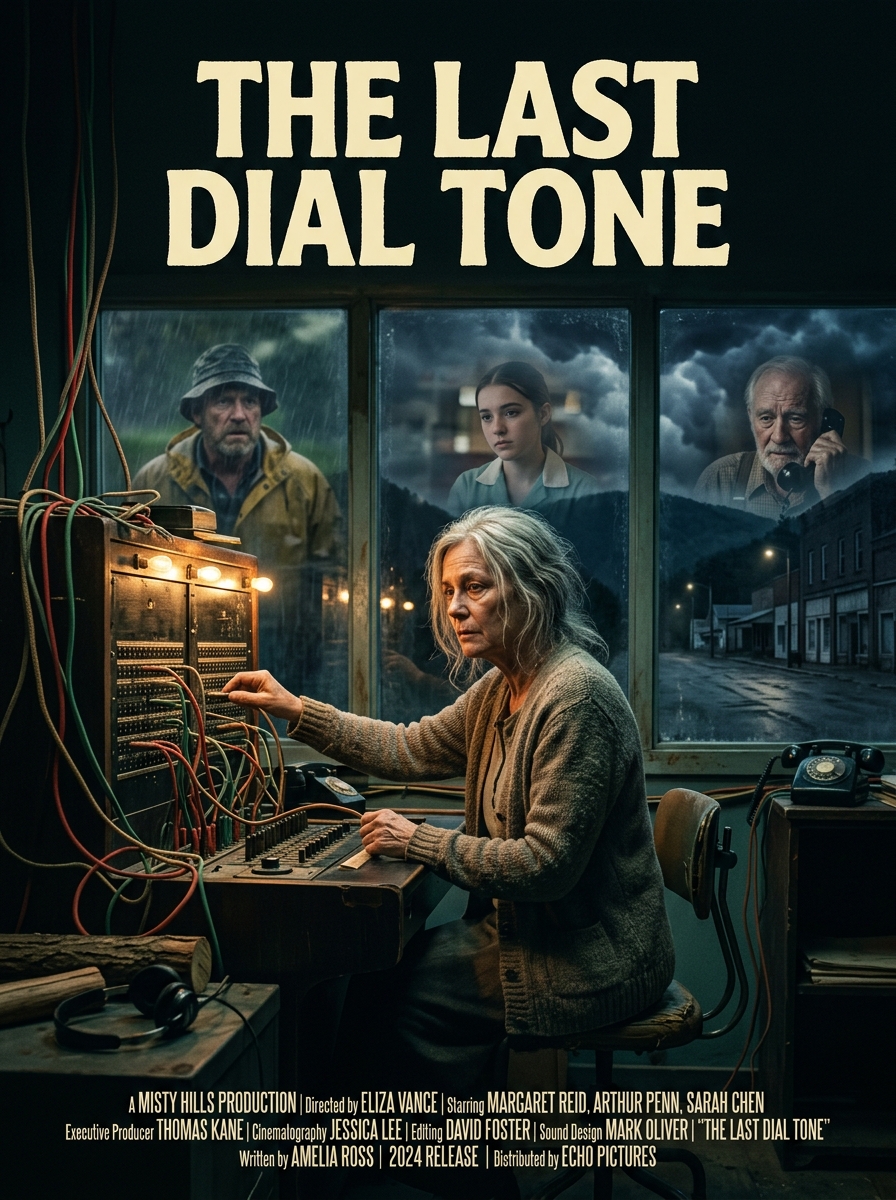
The Last Dial Tone
8/10A bankrupt regional phone company’s final operator spends her last week recording farewell calls from isolated rural residents, uncovering a hidden portrait of a dying community while confronting the secret reason she never left it.
A distinctive and emotionally rich premise with strong thematic depth and a compelling climax, though its quiet, character-driven tone may limit mainstream commercial appeal.
In the Appalachian town of Bell’s Crossing, 62-year-old switchboard operator Ruth Elkins learns the independent telephone exchange she has worked at since high school is shutting down forever, replaced by automated systems from a national telecom giant. A young audio documentarian arrives to archive the final week of live operators in America, expecting quaint nostalgia but instead capturing raw, intimate calls from widowers, addicts, farmers, estranged siblings, and lonely night workers who still rely on Ruth’s voice more than the technology itself.
As the cameras roll, the documentary crew becomes entangled in the town’s emotional collapse. Businesses close, residents quietly relocate, and Ruth’s recordings begin revealing an unspoken local tragedy connected to a deadly mining accident decades earlier. The filmmaker discovers Ruth has secretly maintained disconnected phone lines for grieving families who still call the numbers of lost loved ones just to hear old answering machine messages. The boundary between observer and participant erodes as the crew debates whether documenting suffering is preserving history or exploiting it.
On the exchange’s final night, a severe storm knocks out cellular service across the county, forcing the obsolete switchboard back into emergency use one last time. Ruth coordinates rescue calls through failing analog equipment while the documentarian broadcasts the live recordings online, unexpectedly drawing national attention to the forgotten town. After the crisis passes, the phone company shutters the building anyway, but Ruth leaves behind an audio archive that transforms the film from a nostalgic obituary into a living testimony about connection, memory, and the cost of disappearing places.
Cinematic drama-documentary hybrid poster. A weathered woman in her early 60s with silver hair and tired eyes sits alone at an old analog telephone switchboard glowing in a dark rural exchange office. Tangled patch cords drape like veins across the frame. Behind her, faint ghostlike reflections of rural callers appear in glass windows: a farmer in rain gear, a teenage girl in a diner uniform, an elderly widower holding a rotary phone. Outside the windows, storm clouds gather over Appalachian hills and abandoned storefronts. Color palette of faded teal, sodium-yellow, rust, and deep midnight blue. Moody practical lighting from blinking switchboard bulbs and fluorescent fixtures. Atmosphere nostalgic, intimate, melancholic, quietly urgent. Visual style combines cinematic realism with documentary grit, subtle film grain, natural textures, emotional realism, A24-style composition.