The Cartographer of Lost Things
The true, forgotten story of Isobel Witherell, a 19th-century British explorer who, dismissed by the Royal Geographical Society, secretly charted not geographical locations, but the emotional landscapes of vanished civilizations, believing their lost feelings held the key to preventing future collapses—a journey that takes her from the crumbling ruins of forgotten empires to the uncharted depths of her own haunted past as she races against a shadowy organization seeking to weaponize these powerful, suppressed memories.
“The Cartographer of Lost Things” follows the true, forgotten story of Isobel Witherell, a 19th-century British explorer who, dismissed by the Royal Geographical Society, secretly charted not geographical locations, but the emotional landscapes of vanished civilizations, believing their lost feelings held the key to preventing future collapses—a journey that takes her from the crumbling ruins of forgotten empires to the uncharted depths of her own haunted past as she races against a shadowy organization seeking to weaponize these powerful, suppressed memories.
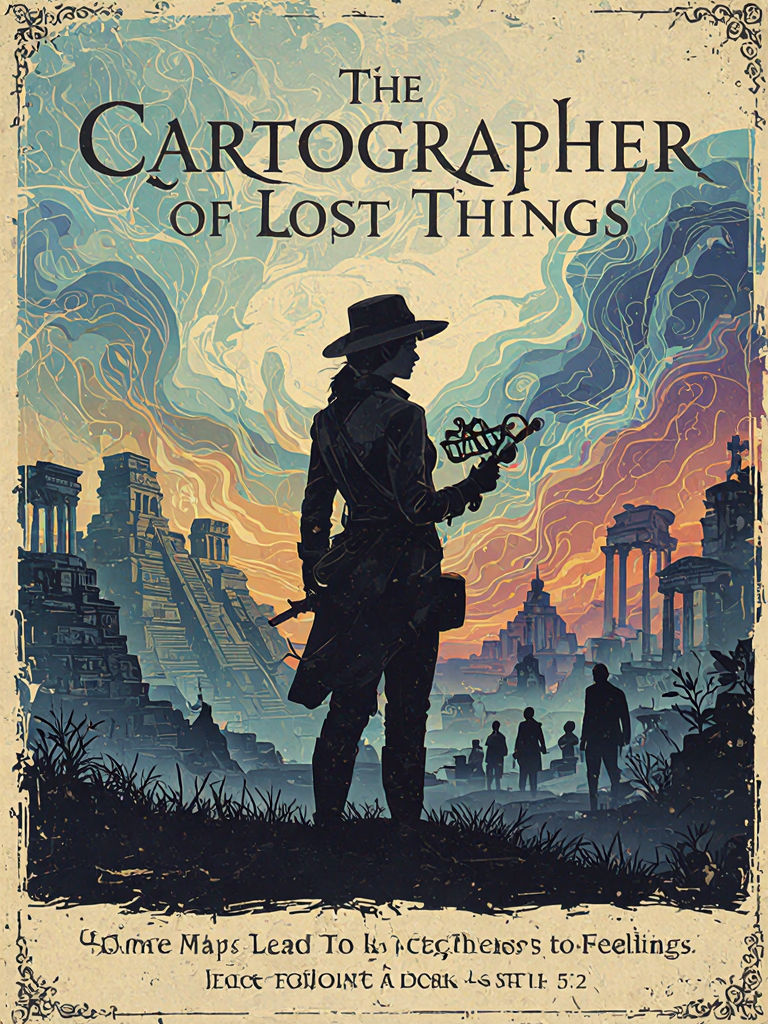
A dramatic movie poster for "The Cartographer of Lost Things". A lone figure, Isobel Witherell (late 30s, determined, dressed in practical but elegant 19th-century explorer clothing – think tailored trousers, sturdy boots, a slightly worn leather jacket, and a wide-brimmed hat), stands silhouetted against a swirling, ethereal landscape. This landscape is *not* a physical place, but a composite of fragmented architectural ruins (Mayan pyramids, Roman arches, Mesopotamian ziggurats) dissolving into nebulae and glowing emotional energy – think blues, violets, and deep oranges. Isobel is holding a complex, ornate cartographer's tool – a sextant adapted to measure *feeling* rather than latitude/longitude – and a spectral map is faintly visible, overlaid on the ruins, depicting swirling patterns of light and shadow representing emotions. In the background, subtly obscured by mist and shadow, are hints of figures in dark suits – the shadowy organization. They are not directly visible, just suggested. The title "The Cartographer of Lost Things" is prominently displayed in a slightly distressed, antique-looking serif font, perhaps with a subtle glow. Below the title, in smaller text: “Some maps lead to places…others to feelings.” The overall mood should be atmospheric, mysterious, and slightly melancholic, with a sense of adventure and peril. A vintage, slightly faded color palette would be ideal. Focus on conveying the emotional weight of lost civilizations and the power of memory. **Prompt:** cinematic movie poster, “The Cartographer of Lost Things”, 19th century British explorer woman, Isobel Witherell, silhouetted, holding ornate cartographer’s tool, spectral map overlay, swirling ethereal landscape, fragmented ruins of ancient civilizations (Mayan, Roman, Mesopotamian), emotional energy, blues, violets, oranges, shadowy figures in dark suits obscured in mist, distressed antique serif font, atmospheric, mysterious, melancholic, adventure, peril, vintage faded color palette, dramatic lighting, high detail, 8k, --ar 2:3 --style cinematic --v 5.2