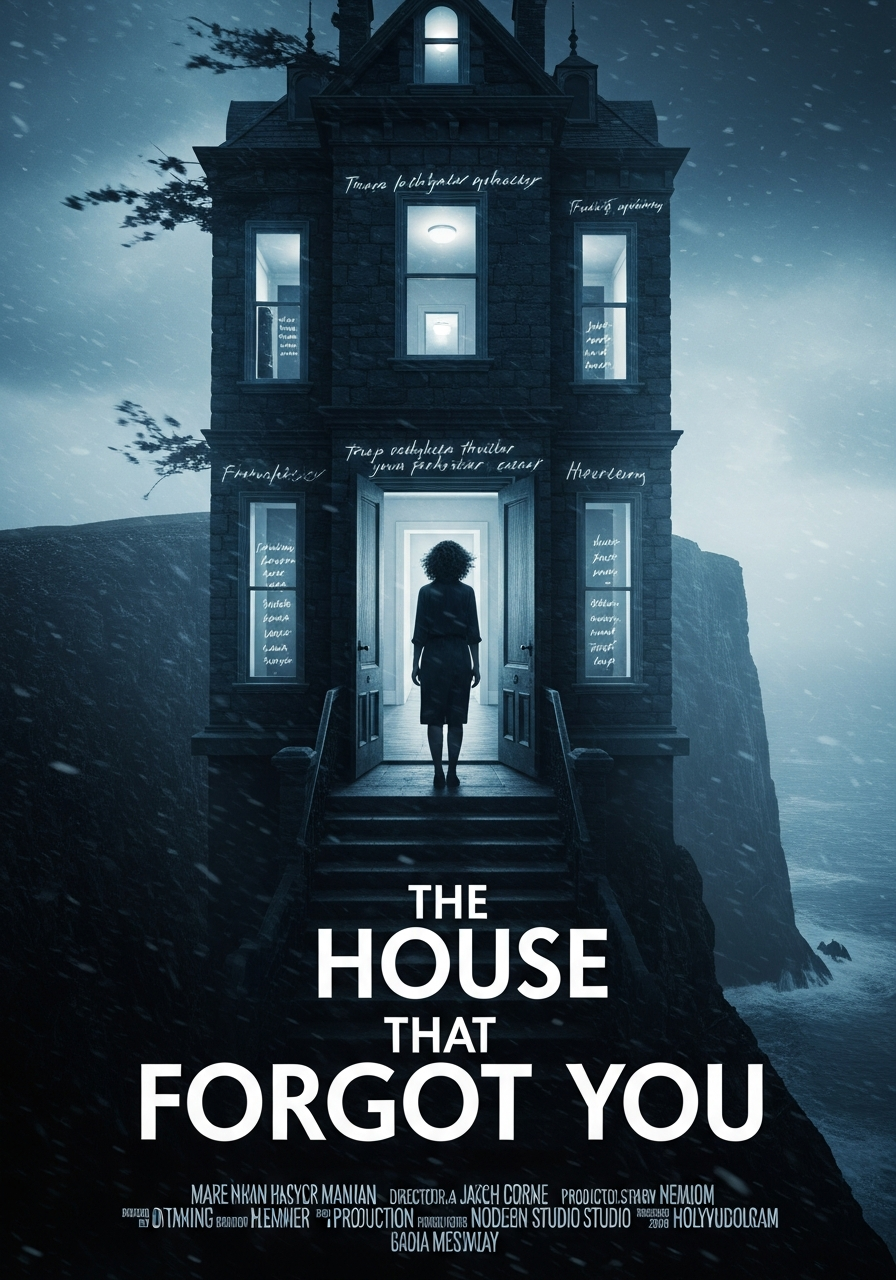
The House That Forgot You
8/10A lonely handwriting analyst investigating a reclusive author’s disappearance becomes trapped in a mansion that subtly alters itself to erase her identity—and replace it with his.
A highly original and atmospheric concept with strong psychological-horror appeal and solid plot coherence, though its commercial viability may be limited by its introspective and surreal nature.
Renowned but isolated handwriting analyst Mara Keene is hired to authenticate the final manuscript of Adrian Lorne, a cult novelist who vanished without a trace. When she arrives at Lorne’s remote estate—a sprawling, antique-filled mansion carved into a coastal cliff—she’s greeted only by a terse housekeeper and a strange instruction: stay on the paths marked in Lorne’s handwriting. Mara dismisses the warning, but soon notices bizarre inconsistencies—rooms she swears weren’t there the night before, journals written in her own style that she doesn’t remember drafting, and a growing sense that the house is observing her work.
During her investigation, Mara uncovers evidence suggesting Lorne believed the mansion had a consciousness of its own, shaping itself around the emotional vulnerabilities of its occupants. As she digs deeper, the building begins to warp more aggressively, rewriting notes she’s made, shifting staircases, and erasing reflections from mirrors. Mara becomes convinced that the house absorbed Lorne—folding him into its architecture—and now intends to do the same to her, replacing her memories with his.
In the final act, Mara attempts to escape, only to find that the house has sealed all exits and is rewriting its halls into pages of Lorne’s manuscript. She confronts the last remnant of Lorne—an echo of his voice guiding the house’s changes—and refuses to surrender her identity. By intentionally scrawling chaotic, contradictory messages across the walls, she destabilizes the mansion’s ability to maintain a single narrative. As the structure collapses into a maze of unfinished rooms, Mara escapes through a breach in the cliffside. But in the epilogue, as she tries to rebuild her life, she notices her handwriting beginning to shift—back toward Adrian Lorne’s style.
A lone woman in her early 30s with curly dark hair stands in the threshold of a cliffside mansion. The house looms impossibly tall, windows rearranged at unnatural angles. Interior hallways glow faintly with handwritten words forming along the walls. Wind whips from the stormy ocean below. Color palette: desaturated blues, bone white, and deep charcoal. Lighting: harsh contrast, noir-inspired shadows. Mood: claustrophobic, intellectual dread. Visual style: psychological thriller realism with subtle surreal distortions.