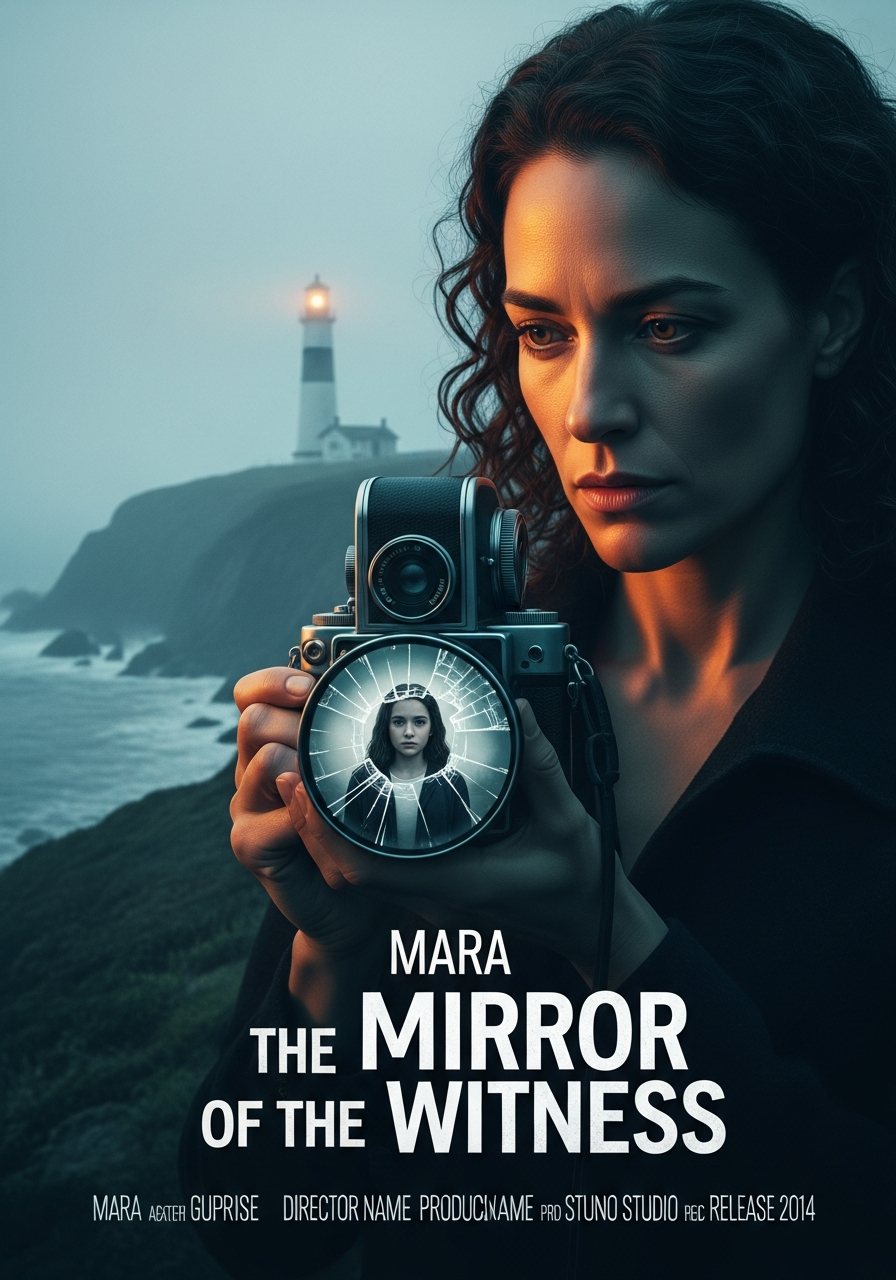
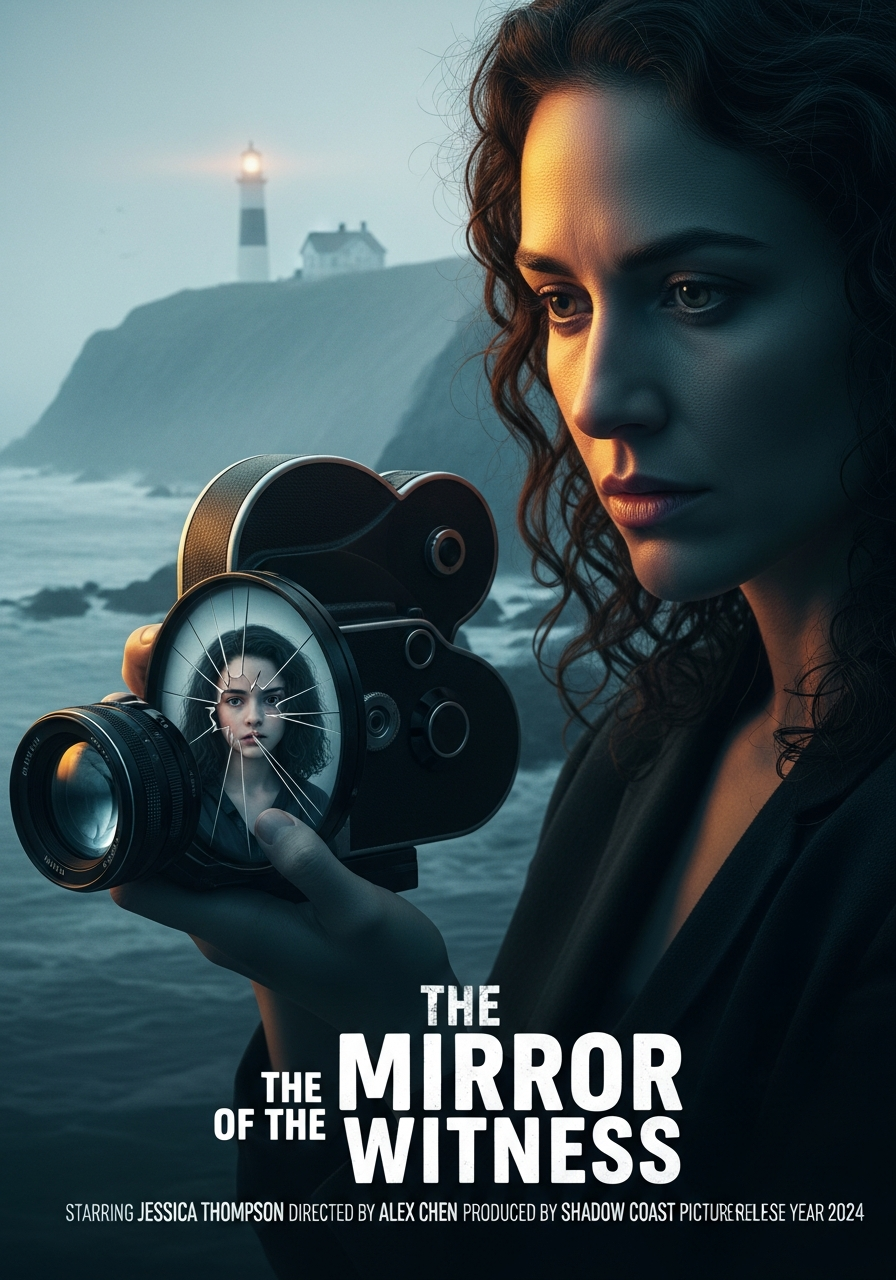
 Real brand text and missing full credit block reduce the overall quality. Issues: real existing brand/logo (Olympus text on lens), credit block missing or incomplete, text distortion/artifact (misspelling in 'RELESE')
The Mirror of the Witness
8/10A documentary filmmaker investigating a decades-old disappearance becomes convinced her own mind is fabricating evidence, forcing her to confront whether she’s uncovering a buried truth—or documenting her own psychological unraveling.
A psychologically rich, high‑concept thriller with strong originality and commercial potential, though its complexity risks challenging broader audience accessibility.
Documentary filmmaker Mara Ellison travels to a remote coastal town to investigate the 1994 disappearance of teenage sisters Lila and Brynn Carter. The town’s residents insist the girls drowned, yet no bodies were ever found. As Mara interviews key witnesses—now visibly uncomfortable adults—she uncovers contradictions, forgotten details, and eerie gaps in collective memory. Her footage reveals strange reflections and visual distortions that no crew member recalls witnessing in person. Mara begins to suspect a long-buried conspiracy—and possibly a survivor in hiding.
As she digs deeper, her interviews turn confrontational. Witnesses accuse her of putting words in their mouths. Her editor flags continuity errors that shouldn’t exist: interviews conducted on different days appear to show Mara wearing the same clothes…or mouthing lines she doesn’t remember saying. Sleep-deprived and isolated, she becomes convinced someone is manipulating her footage—or her perception—to silence the truth. But when a reel of 1994 raw footage surfaces showing a teenage girl who looks exactly like Mara, she realizes the case may be entwined with her own forgotten past.
Mara races to confront the final surviving witness, an aging lighthouse keeper who claims the girls never left the cliffs at all—they simply “became someone else.” As the line between reality and memory finally collapses, Mara discovers the truth: she is Lila, the surviving sister who repressed the trauma and reinvented her identity. The disappearance wasn’t a mystery to solve but a memory to remember. In the film's devastating final sequence, she turns the camera on herself to confess both the truth and her fear—revealing that the documentary she set out to make was always about her own escape from the past.
A moody, psychological-thriller poster set on a foggy coastal cliffside. Foreground: Mara, a woman in her mid-thirties with dark curly hair, intense eyes, holding a vintage documentary camera pointed slightly downward. Her reflection in a fractured glass lens shows her younger self—a teenage girl she doesn’t recognize. Background: a lonely lighthouse, dimly lit, partially obscured by coastal mist. Color palette: desaturated blues and gray-green tones, with a subtle warm spotlight on Mara’s face. Lighting: soft, eerie, oceanic gloom. Mood: unsettling, introspective. Style: hyper-realistic cinematic photography with psychological tension.