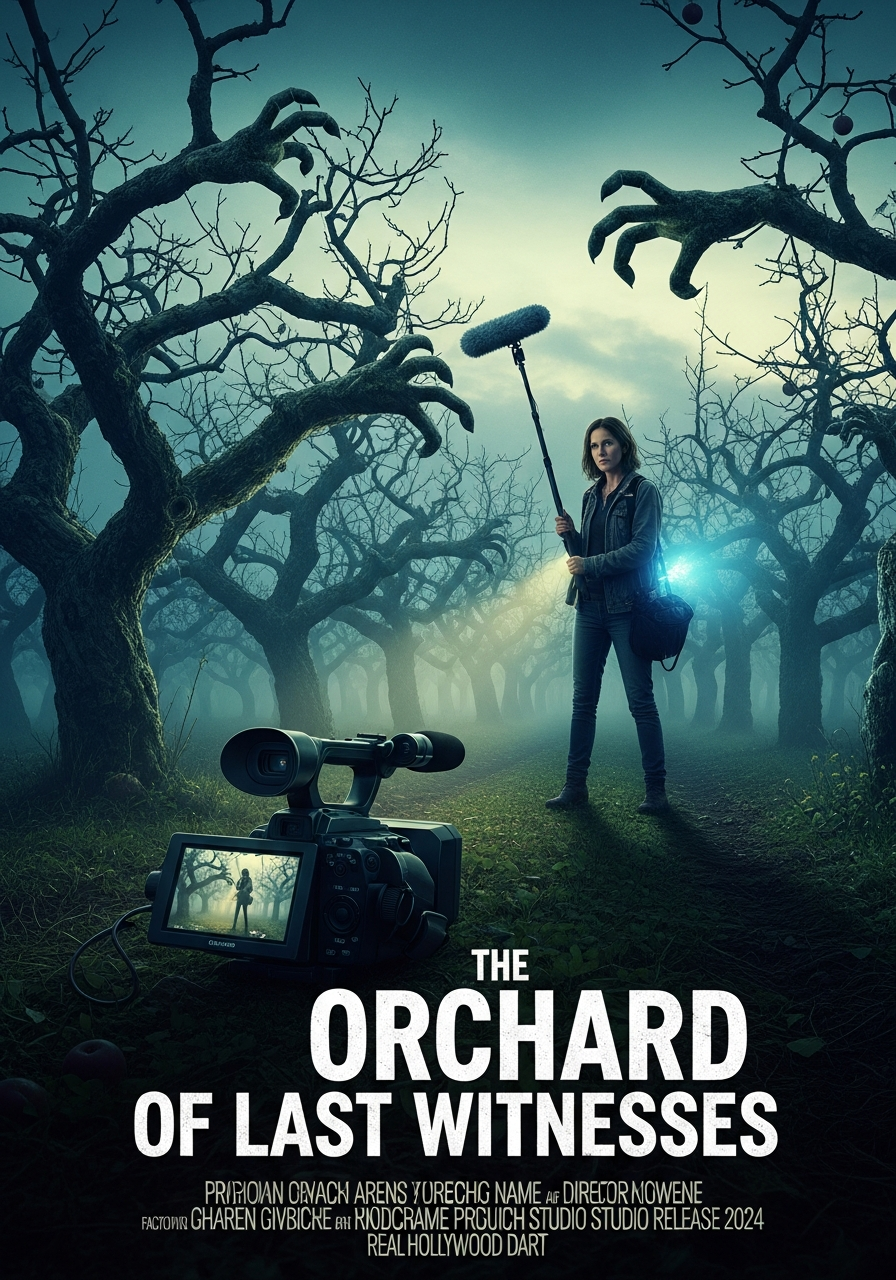
The Orchard of Last Witnesses
8/10A documentary crew investigating a rural family's century‑old orchard discovers its trees preserve the final memories of the dead—and have begun recording their own.
A highly original and atmospheric concept with strong horror-documentary appeal, though its commercial reach may depend on careful pacing and clarity around the orchard’s mythology.
A small, independent documentary team travels to a fading Appalachian town to investigate a local legend: an abandoned family orchard where, according to decades of whispered folklore, the trees grow in the exact spots where missing people were last seen. Initially intending to debunk the myth, the crew interviews aging residents, collects archival photos, and uncovers county records that reveal an unnerving pattern of disappearances clustered around the land for over a century.
As they begin filming inside the orchard, their equipment captures impossible phenomena—faint audio fragments of unknown voices, blurred visual distortions drifting between the branches, and sudden temperature drops at locations matching historical disappearance sites. The deeper they probe, the more they realize the orchard is not haunted by spirits—but by something far older that records the final perceptions of anyone who dies within its reach. These memories begin to replay for the crew, revealing glimpses of victims who seemed to vanish into the trees themselves.
When one team member goes missing, the remaining crew is forced to confront the horrifying truth: the orchard is expanding, its roots spreading across the valley, hunting for new memories to consume. In a desperate final attempt to escape, they turn the camera on themselves, documenting the final hours as they race to save their friend and flee the land—leaving behind footage that suggests the orchard is now following them, growing wherever they go, waiting to record its next witness.
Cinematic documentary‑horror poster. A worn, overgrown orchard at dusk, twisted apple trees with gnarled branches resembling grasping hands. In the foreground, a handheld video camera lies on the ground, its screen flickering with the blurry silhouette of a missing crew member. Main character: a 30s female documentary director, jeans, flannel jacket, holding a boom mic like a protective weapon, illuminated by eerie bioluminescent glow from the trees. Color palette: desaturated greens, bruised purples, sickly moonlight yellow. Lighting: harsh contrast with soft fog creeping between trunks. Mood: foreboding, investigative, grounded realism blended with supernatural dread. Visual style: gritty, handheld‑camera aesthetic with subtle spectral distortions.