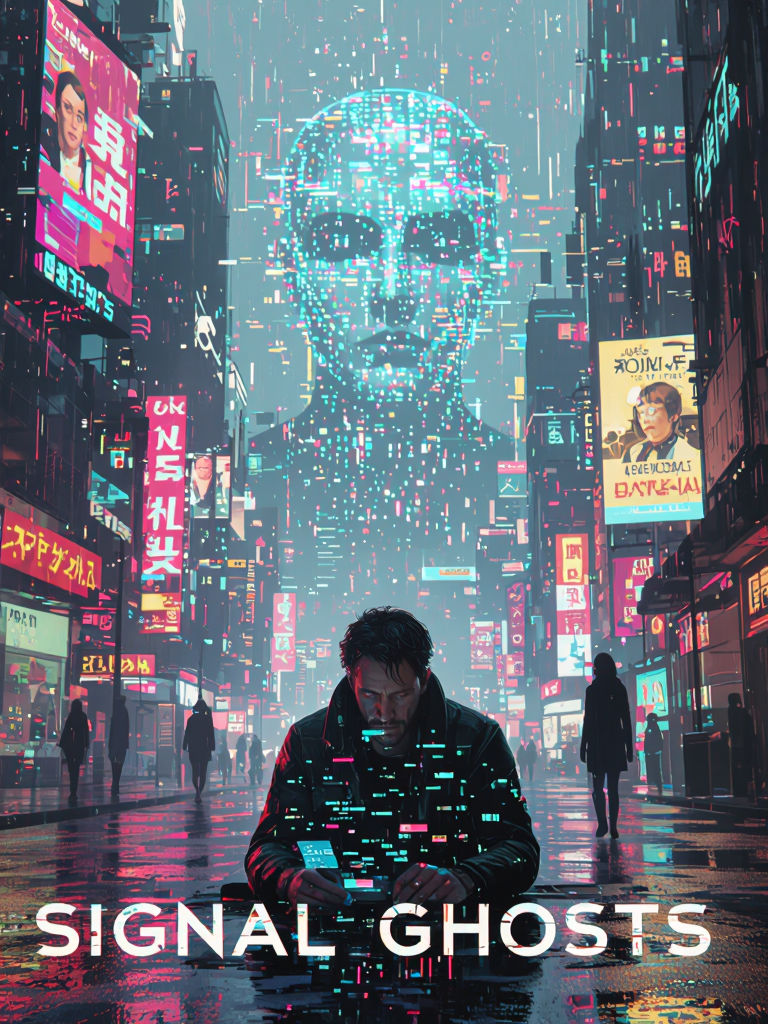
Signal Ghosts
In a near-future metropolis powered by neural networks, a washed-up “memory jockey” who edits and broadcasts people’s cherished recollections discovers a corrupted signal revealing fractured, impossible realities—and a conspiracy to weaponize collective memory—forcing him to team up with a skeptical AI ethicist to unravel a digital labyrinth of false narratives and rogue algorithms before the city—and its inhabitants’ identities—are overwritten entirely.
“Signal Ghosts” In a near-future metropolis powered by neural networks, a washed-up “memory jockey” who edits and broadcasts people’s cherished recollections discovers a corrupted signal revealing fractured, impossible realities—and a conspiracy to weaponize collective memory—forcing him to team up with a skeptical AI ethicist to unravel a digital labyrinth of false narratives and rogue algorithms before the city—and its inhabitants’ identities—are overwritten entirely.
Signal Ghosts, near-future metropolis, rain-slicked neon streets, towering holographic advertisements glitching and fractured, a lone figure (washed-up memory jockey, weary expression, late 30s/early 40s) hunched over glowing data streams, fragmented memories swirling around him like ghosts, a stark contrast of bright digital light and deep shadows, in the background, a looming, abstract representation of a neural network, subtly menacing, a female figure (AI ethicist, sharp, intelligent) partially visible as a holographic projection offering a questioning gaze, overall mood: cyberpunk, noir, unsettling, high detail, cinematic lighting, dramatic composition, gritty texture, art by Syd Mead and Blade Runner 2049, title "Signal Ghosts" prominently displayed.